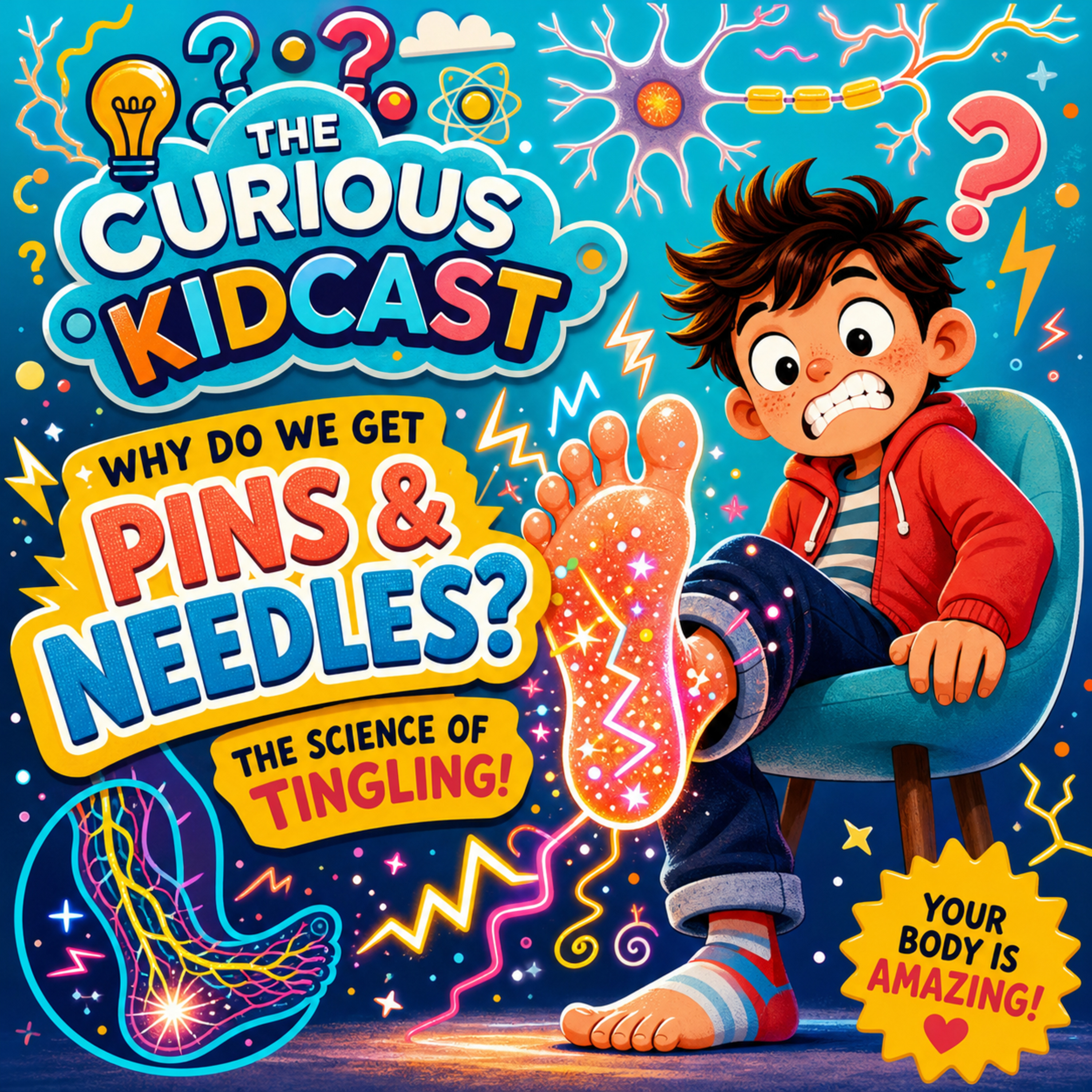
Why do we get pins and needles?
Listen to this episode
Show Notes
About This Episode
You're sitting on the floor, minding your own business, being a completely normal human person, and then you stand up and your foot has just, completely, quit. It's fizzing. It's tingling. You try to walk and you look like a baby giraffe who's just been told some very surprising news.
In this episode, host Charlie dives into one of the most-asked questions we've ever received: why do we get pins and needles? The answer involves electricity, lightning-fast signals, 86 billion nerve cells, and a nerve with the worst nickname in history. It's one of those everyday things that turns out to be absolutely extraordinary once you know the science behind it.
What You'll Learn in This Episode
- What pins and needles actually is and why it happens
- How your nervous system works like an internet inside your body
- Why nerve signals travel faster than a Formula One racing car
- What happens to your nerves when blood flow gets cut off
- Why shaking your leg makes pins and needles go away
- The truth about the “funny bone” (hint: it's not a bone)
- Why your body contains 100,000 km of biological wiring
- How ancient Romans, medieval knights, and astronauts all share this experience
Key Science Facts from This Episode
Your nerves are electrical cables. Every feeling you experience, every movement you make, is powered by tiny electrical signals travelling through your nervous system. These signals can travel at up to 120 metres per second — faster than any Formula One car on the track.
Pins and needles happen when a nerve gets squashed. When you sit in a funny position, your body weight presses on nerves and the blood vessels that feed them. Without blood delivering oxygen and glucose, the nerve starts firing confused signals to your brain — and that fizzy, tingling feeling is your brain trying to make sense of the chaos.
It's your body protecting you. The discomfort of pins and needles is a deliberate warning system. It forces you to move before any real damage is done to your nerves or muscles.
Your body is extraordinary. You have roughly 86 billion nerve cells inside you. If you stretched all your nerve fibres into a single line, they'd wrap around the Earth two and a half times.
Episode Quiz — Test Your Knowledge
Listen to the episode first, then see how many you can get right.
Perfect For
- Children aged 7–11 who love science and asking big questions
- Parents looking for entertaining, educational content to enjoy with kids
- Homeschooling families covering human biology or Key Stage 2 science
- Teachers looking for engaging classroom listening material
- Anyone curious about how the human body works
Related Topics to Explore
If this episode sparked your curiosity, you might also enjoy exploring: the human nervous system, neurons and synapses, the speed of electricity, reflex actions, and how the brain processes sensation. These topics are covered in Key Stage 2 science and make brilliant science fair project ideas.
Got a Question You'd Like Answered?
Every episode starts with a question from a curious kid just like you. Send yours in and it could be the next one Charlie explores on the show.