
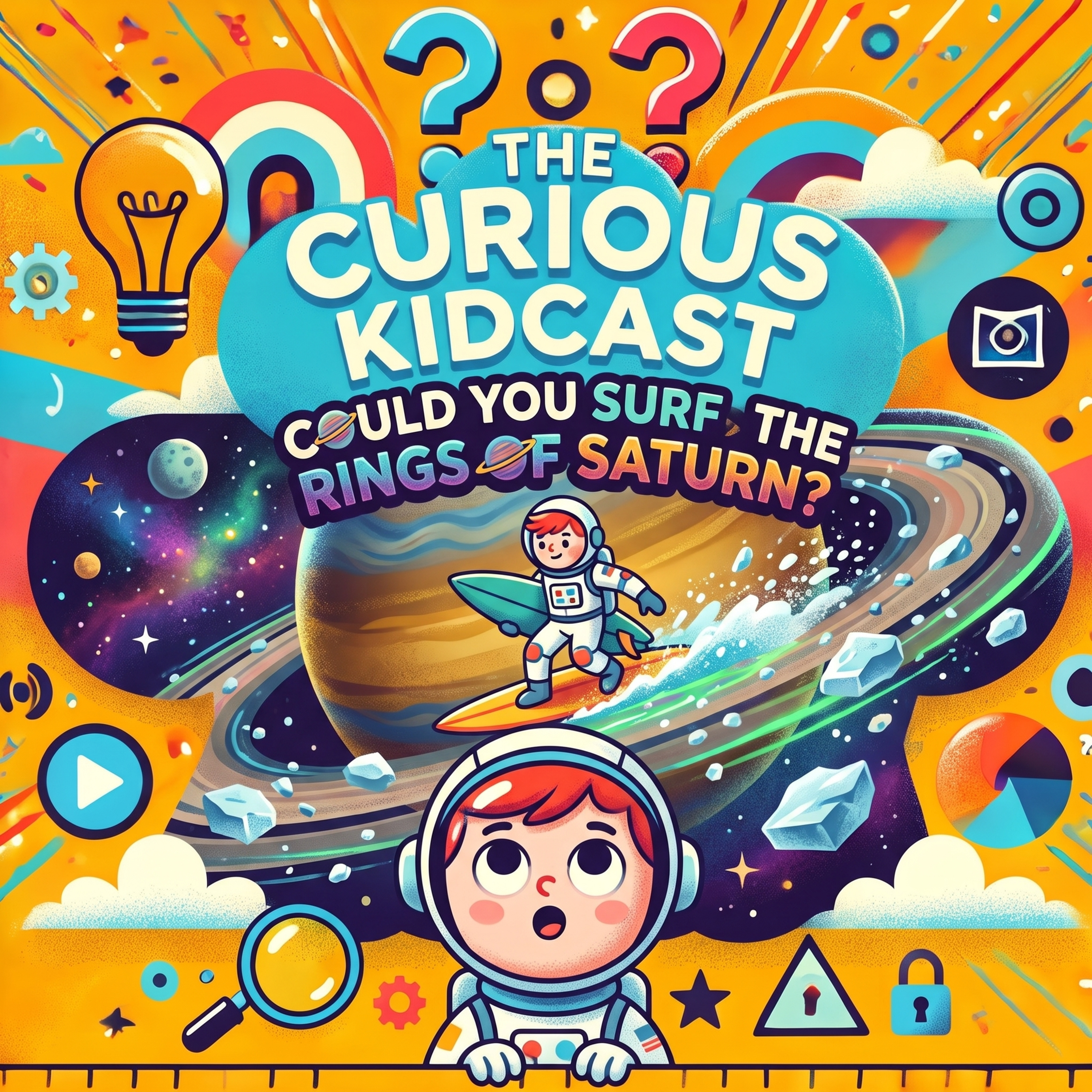
Could you surf the rings of Saturn?
Listen to this episode
What You'll Learn
- The Great Optical Illusion: Why Saturn's rings look like a solid track from Earth, but are actually made of billions of chunks of water ice and space rock.
- Supersonic Speeds: How the ice chunks orbit the gas giant at mind-blowing speeds of up to 45,000 miles per hour!
- Gravity Waves: How tiny "shepherd moons" like Daphnis use their gravity to pull the ice into towering, two-mile-high ripples.
- Space Engineering: The futuristic tech (like magnetic deflector shields and rocket thrusters) you would need to build the ultimate "Space Board."
- If you could design your own rocket-powered "Space Board" to ride Saturn's rings, what special gadgets would you put on it?
- Why did early astronomers like Galileo think Saturn had "ears" instead of rings?
- How are the gravity waves on Saturn different from the ocean waves you see at the beach?
Try This at Home
Show Notes
Grab your neon-orange spacesuit and rocket-powered surfboard! In this week's thrilling, out-of-this-world episode of The Curious Kidcast, Charlie answers an amazing question from a listener: Could you surf on the rings of Saturn?
Join us as we blast off into the solar system to learn the fun facts about what Saturn's rings are actually made of. We'll discover the extreme speeds of space ice, the freezing temperatures of the cosmic blender, and the incredible two-mile-high "gravity waves" created by tiny shepherd moons. It's the perfect mix of extreme sports imagination and real-world astronomy to help your family learn and laugh together!
Homeschooling & Parenting Tip:
This episode is fantastic for unit studies on the solar system, gravity, and states of matter. It’s a great, screen-free way for
kids
to engage with high-level physics concepts while having
fun
Stick around for the interactive 3-question quiz at the end to test listening comprehension.
What Kids Will Learn in This Episode
- The Great Optical Illusion: Why Saturn's rings look like a solid track from Earth, but are actually made of billions of chunks of water ice and space rock.
- Supersonic Speeds: How the ice chunks orbit the gas giant at mind-blowing speeds of up to 45,000 miles per hour!
- Gravity Waves: How tiny "shepherd moons" like Daphnis use their gravity to pull the ice into towering, two-mile-high ripples.
- Space Engineering: The futuristic tech (like magnetic deflector shields and rocket thrusters) you would need to build the ultimate "Space Board."
Family & Homeschool Discussion Questions
- If you could design your own rocket-powered "Space Board" to ride Saturn's rings, what special gadgets would you put on it?
- Why did early astronomers like Galileo think Saturn had "ears" instead of rings?
- How are the gravity waves on Saturn different from the ocean waves you see at the beach?
Hands-On Extension Activity: The Ice Collision Experiment
Try this at home: Place several ice cubes in a large bowl of water. Swirl the water rapidly in a circle using a spoon to simulate Saturn's orbit. Watch how the ice chunks crash, bump, and group together. This is exactly what the rocky ice debris does in Saturn's rings—just at a much faster speed and without the liquid water! A perfect visual science activity for nature and space lovers.
Connect & Subscribe
Do your kids have a curious question of their own? Send it to Charlie at curiouskidcast.com.
Follow and subscribe on Apple Podcasts, Spotify, or your favorite family podcast app so you never miss an adventure!
The Curious Kidcast. Tagged under: Science, Kids, Parenting, Homeschooling, Nature, Learn, Facts, Fun, Family.